
March 9, 2026 - by Vaishali Rathod
It’s Monday morning, and your inbox is flooded with questions from employees:
- “Can I carry over my unused leave?”
- “What’s the parental leave policy for my region?”
- “How do I update my tax information after relocation?”
As an HR professional, you know the answer is somewhere in your system, but finding it means digging through outdated documents, interpreting conflicting policies, and manually guiding each employee. Day after day, these repetitive queries consume hours of your team’s time, leaving little room for strategic initiatives and quietly draining productivity across the department.
Autonomous AI agents change this model entirely. Instead of simply retrieving documents, they understand employee intent, apply policy logic, and can guide or complete actions within governed boundaries.
This blog explores how agentic AI differs from traditional HR search, how it works in practice, where it delivers measurable time savings, and what HR leaders should consider when developing an agentic ai system.
What is Traditional Search in HR Systems?
Traditional HR search relies on keyword-driven or menu-based lookup across HR platforms, portals, and policy repositories. While it makes information technically available, it creates significant challenges for HR teams who must interpret, verify, and communicate answers.
Key characteristics
- HR must sift through multiple documents to find accurate policy details.
- Information is document-centric, not task-centric, requiring manual interpretation.
- Systems cannot understand employee intent or apply policy logic automatically.
- HR teams are responsible for translating results into actionable guidance for employees.
Example
When an employee asks, “What’s the parental leave policy?” HR may need to:
- Check multiple versions of the policy across regions.
- Verify eligibility based on employee role, tenure, and location.
- Respond with an accurate, compliant answer to the employee.
This manual process is time-consuming, error-prone, and repetitive, forcing HR teams to spend hours every week on tasks that could be automated, instead of focusing on strategic initiatives.
The Hidden Cost
When HR teams spend an enormous amount of time searching for information on policies, benefits, onboarding steps, leave rules, compliance documentation, and more, the result is:
- Lost productivity due to hours spent manually searching for policies, benefits, and compliance information.
- Delayed decisions since HR must verify details across multiple documents and systems before responding.
- Employee frustration because responses are slow, inconsistent, or require repeated follow-ups.
- Increased risk of errors or inconsistent answers from relying on manual information retrieval.
In large organizations, this inefficiency quietly adds up to thousands of wasted hours each year, turning HR into a reactive service desk rather than a proactive business partner.
How Autonomous AI Agents Transform Traditional Search
AI agents move HR from static search to autonomous reasoning and action. Modern systems reason, plan, decide, and act autonomously to achieve goals on behalf of users.
Instead of saying:
“Here’s the document you asked for.”
Agentic AI applications say:
“I have understood your situation, applied the right policy, and completed the task for you.”
In HR, autonomous AI agents can:
- Interpret employee intent: Example: An employee types, “I’m relocating to the US next month. What changes for me?” Instead of just listing mobility policies, the AI system understands that this involves payroll adjustments, tax implications, benefits eligibility, and local labor rules. It provides personalized guidance based on the employee’s role, grade, and destination country.
- Apply company rules and compliance logic: Example: An employee asks, “Can I carry forward my unused leave?” The AI checks region-specific policy, employment type, tenure, and current leave balance, then provides a clear answer aligned with company rules and local labor regulations.
- Orchestrate workflows across systems: Example: During onboarding, a new hire asks, “What tasks are pending from the onboarding checklist for me?” The AI pulls data from HRIS, document management, IT provisioning, and training systems to generate a consolidated list and highlight outstanding tasks.
- Execute actions (with approvals where required): Example: An employee says, “Apply 5 days of annual leave starting March 10.” The AI verifies eligibility, checks team calendar conflicts, submits the leave request, routes it to the manager for approval, and confirms submission, without navigating multiple systems.
- Learn continuously from outcomes: Example: If employees frequently ask follow-up questions about a specific benefit, the AI identifies gaps in clarity and improves its responses over time, refining explanations based on successful resolutions and HR feedback.
Agentic AI Applications vs. Traditional Search – A Comparison
While traditional HR search improves access to information, it still places the burden of interpretation and action on employees and HR teams. Agentic AI shifts this responsibility to the system, moving from keyword retrieval to contextual understanding, decision support, and workflow execution.
The comparison below highlights the fundamental change in how HR services are delivered.
| Dimension | Traditional HR Search | Agentic AI |
|---|---|---|
| Interaction Style | Keyword-based lookup | Conversational, goal-driven |
| Understanding | Surface-level keyword matching | Context-aware reasoning |
| Output | Documents and links | Decisions, recommendations, completed actions |
| User Effort | High manual interpretation required | Low – AI resolves intent |
| Workflow Execution | Not supported | Built-in orchestration |
| Adaptability | Static results | Learns and improves |
| Business Impact | Incremental efficiency | Transformational productivity |
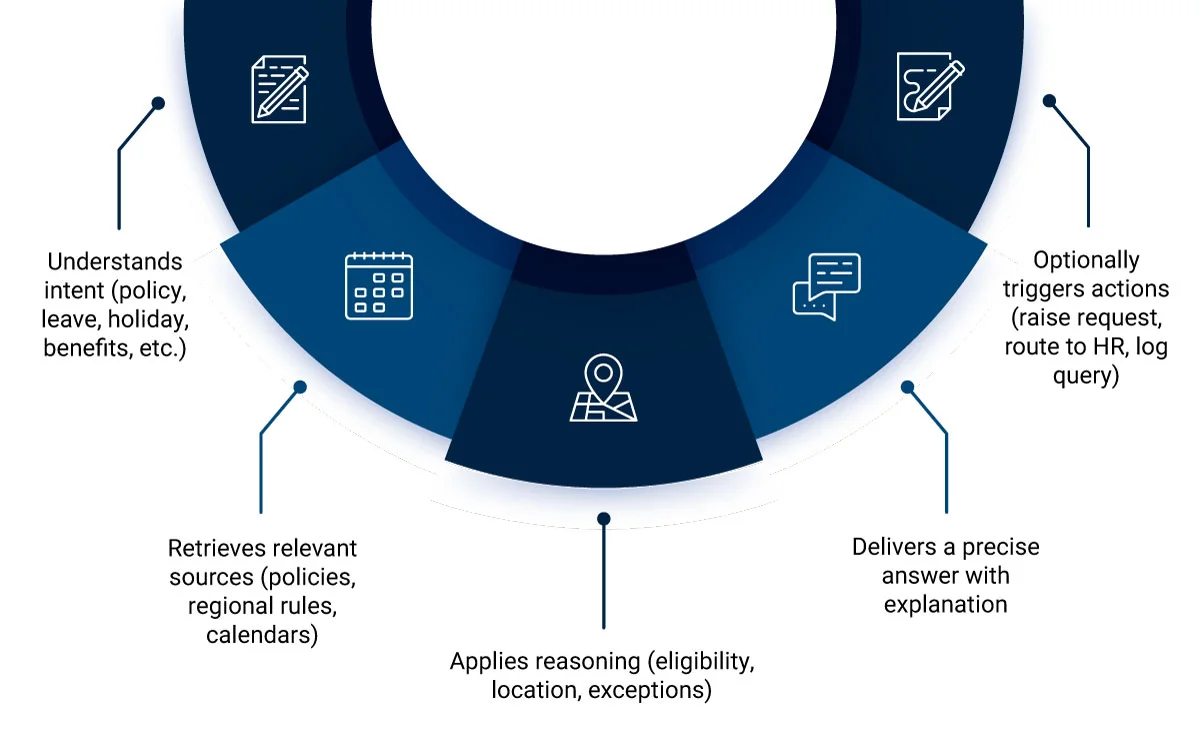
Conceptual Flow of Agentic AI in HR
Autonomous AI agents follow an end-to-end reasoning loop designed to resolve employee needs from start to finish. They combine natural language understanding, contextual policy interpretation, and workflow orchestration to move from question to outcome, often in a single interaction.
When a user asks a question in natural language, the autonomous AI agent:
HR Use Cases Where Agentic AI Saves Time
The real impact of agentic AI becomes clear in high-volume, repetitive HR interactions that traditionally consume disproportionate time and effort. By resolving intent instantly and accurately, it removes friction from everyday employee requests and dramatically reduces manual workload.
- Policy Queries: Instantly interprets region-specific leave policies, benefits eligibility, remote work rules, and compliance requirements—delivering clear, personalized answers instead of generic documents.
- Holiday & Calendar Questions: Provides accurate, location-based holiday information by factoring in country, state, and office-level calendars without HR intervention.
- Leave & Attendance Guidance: Evaluates eligibility, balances, carry-forward rules, and encashment policies—offering precise guidance aligned with company rules.
- Onboarding Support: Generates role-based checklists, tracks document submissions, and clarifies timelines—reducing coordination delays across HR, IT, and hiring managers.
- Employee Self-Service: Resolves routine queries conversationally, significantly lowering HR tickets, emails, and repetitive follow-ups.
Quantifying the Impact: Thousands of HR Hours Saved
Consider a mid-sized organization with 1,000 employees. If each employee raises ~2 HR queries per month, the average handling time per query (HR + employee) comes to around 10–15 minutes. That translates to 4,000–6,000 hours annually spent on repetitive HR interactions.
With agentic AI:
- 70–80% of queries are resolved instantly
- HR involvement is reduced to exceptions only
This directly converts into thousands of productive hours saved, faster employee resolution, and improved HR focus on strategic initiatives.
Ensuring Governance, Trust & Control
Agentic AI in HR is powerful but must also be governed. Because it operates in domains involving sensitive employee data, regulatory compliance, and policy interpretation, the credibility of the system depends on clear boundaries, transparency, and human oversight built into its design.
Key control mechanisms while developing an agentic ai system include:
- Read-only access to approved policy documents
- Region and role-based data boundaries
- Auditable responses with source references
- No autonomous policy creation, only interpretation
- Human override and escalation paths
Implementation Considerations for HR Leaders
The most effective implementations start focused, establish clear guardrails, and scale based on measurable impact. Here are some considerations to keep in mind while developing an agentic ai system:
- Start with high-volume, low-risk queries: Target repetitive policy and leave-related questions first to demonstrate quick wins and measurable time savings.
- Use approved and version-controlled documents only: Ensure the AI is grounded in validated sources to maintain consistency and compliance.
- Clearly define what the agent can and cannot do: Explicitly outline what the agent can interpret, recommend, and execute, and where human review is mandatory.
- Measure success using HR ticket reduction and response time: Track reductions in HR tickets, average resolution time, employee satisfaction, and exception rates to quantify ROI.
- Position the AI as an HR assistant, not a replacement: Communicate that it augments HR capacity, allowing teams to focus on strategic initiatives rather than replacing human expertise.
- Ensure robust change management: Transparent communication, stakeholder alignment, and phased rollout planning will determine whether agentic AI becomes a trusted digital assistant or just another underutilized tool.
The Future of HR: From Manual Search to Autonomous Operations
Traditional HR tools retrieve information, leaving employees and HR teams to interpret and act on it. This manual search process often leads to delays, errors, and repeated back-and-forth with HR, consuming thousands of hours annually. agentic AI applications go further: they understand intent, apply policies, orchestrate workflows, and deliver outcomes autonomously, cutting ticket volumes, accelerating resolutions, and enabling HR to focus on high-value initiatives. Autonomous AI agents also continuously learn from interactions, improving accuracy and efficiency over time. By handling repetitive tasks intelligently, HR can devote more energy to strategic initiatives that drive employee engagement and organizational growth.
If you want to turn your HR function into a proactive, outcome-driven operation, Synoptek can help in developing an agentic ai system that delivers faster, smarter, and more consistent employee experiences. Speak to our experts to explore how autonomous AI agents can transform your HR processes and start realizing measurable time savings and operational impact today.
About the Author

Vaishali Rathod is a Senior Project Manager at Synoptek with over 16 years of experience delivering enterprise technology and digital transformation initiatives. She has strong expertise across Microsoft Power Platform, Microsoft SharePoint, Microsoft Azure, Azure SQL Database, Microsoft Copilot and actively works on initiatives involving Artificial Intelligence. In her role, Vaishali leads end-to-end project delivery, including risk identification, mitigation planning, and escalation management, while ensuring strong collaboration between technical teams and business stakeholders.
Frequently Asked Questions
These agents are intelligent systems that understand employee intent, apply company policies, and complete HR tasks automatically, reducing repetitive work and saving thousands of hours.
They move beyond keyword-based search by reasoning contextually, executing actions, and orchestrating workflows across HR systems, unlike traditional document-centric retrieval.
They can manage policy queries, leave and attendance guidance, holiday and calendar questions, onboarding support, and employee self-service, delivering accurate and instant responses.
It enables HR to automate repetitive queries, reduce manual interpretation, accelerate employee resolution, and allow teams to focus on strategic initiatives.
Effective systems require human oversight, role-based access, auditable responses, read-only access to approved policies, and clear boundaries to ensure compliance, trust, and reliable decision-making.